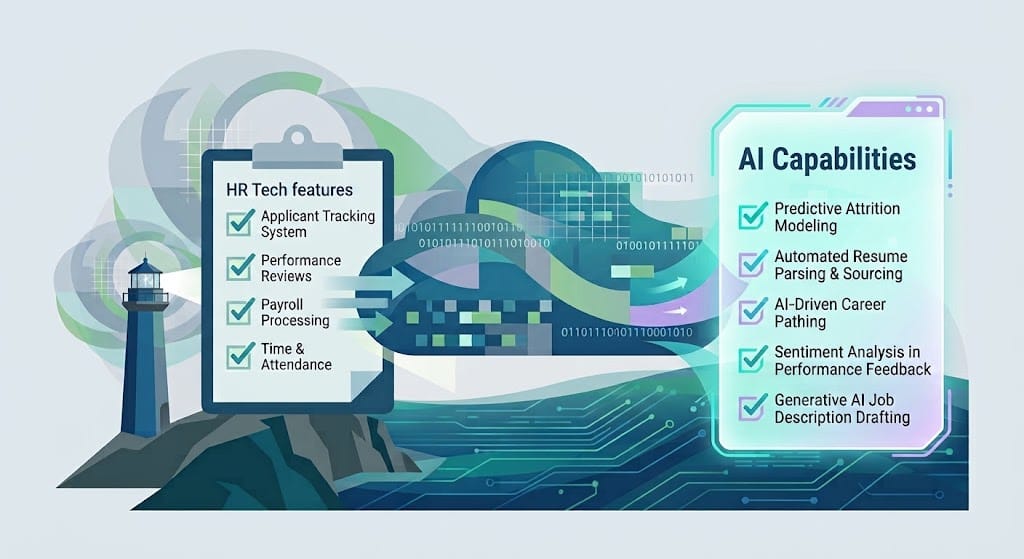
For years, buying HR technology was relatively straightforward; an organisation would define what it thought it needed and then look for an HR system that had those functions and features.
Vendors packaged their technology into handy modules, procurement teams made their checklists and buyers compared those modules. Demonstrations would show how the software performed each function.
It was a logical approach because the HR system, the data it held, and the means employees used to access it were largely part of the same package.
Changes to that are already here.
The emergence of ‘headless’ HR tech, (i.e. the underlying HR data and processing capabilities are separated from the user interface) challenges the traditional methods by which HR tech has been analysed, demonstrated and bought.
And it’s not just another piece of technical jargon for HR professionals to learn.
If headless HR tech develops as expected, it changes what we mean by an “HR system” in the first place; from being an HR application, it in effect becomes an HR intelligence layer.
The easiest way to understand headless technology is to think about the difference between where the HR system is and where people actually use HR information.
In a conventional HR system, an employee logs in to check their holiday balance or download a payslip.
With a headless approach, they can simply ask:
“How many days’ holiday do I have left?” or “Show me my March payslip.”
The tech works in the background, retrieving the relevant information and gives the answer through the application the employee is already using (e.g. Slack, Teams, chatbot). So, the HR system becomes a layer of data that can be accessed whenever and in whatever format it’s needed.
This is sometimes described as “in the flow of work”.
This becomes even more interesting when we introduce AI agents. An AI agent is more than a chatbot that answers questions as it can be given permission to carry out tasks on behalf of a person or organisation.
For example, an AI agent can retrieve HR information, start an onboarding process, identify a compliance issue or initiate a change to an employee record. It doesn’t need to navigate the HR system in the same way that a human does. Instead, it can communicate directly with the underlying technology through an API (Application Programming Interface) which is a way for one piece of software to communicate with another.
This is why headless technology matters to the future of AI in HR.
The AI agent doesn’t need the usual HR screens and menus but just needs access to the data and functions underneath them. In plain terms the user no longer needs to open the HR system at all which leads us to the possibility of what is called “zero-UI” (zero user interface)
This of course causes a massive problem for the way we select HR tech. It’s no longer a question of “Which HR system has the best combination of the modules and features we need?” which works when the technology is packaged as a complete system. When the HR data can be accessed by several different applications, AI agents and specialist systems the module-by-module comparison no longer applies.
A headless HR platform may not necessarily provide every function through its own interface, but it will almost certainly have capabilities that allow an organisation to connect the best specialist tech for a specialist requirement, such as payroll, recruitment or learning & development.
An employee could access HR services through Teams or Slack, and an AI agent could sit across all of them. So we move from buying an HR system to assembling an HR tech environment. At the same time, instead of asking:
“Does the system have payroll?” the question becomes:
“Can this HR data and that payroll capability be securely accessed, connected and used by the people that need it?”
With the HR tech scorecard we’ve been using, this becomes impossible, as we are changing the basis of comparison.
Instead of feature-based criteria, headless selection will have to be capability-based, probing areas such as:
What data can it hold?
What systems can connect to it?
Who can access that data?
Can they interrogate in natural language?
Can an AI agent use it?
Can we control what that AI agent is allowed to do?
Can we prove what happened afterwards?
That last question is significant as Governance will become part of the product instead of just peripheral considerations.
Governance in this sense means the rules and controls that determine who or what can access information, what they can do with it, and how those actions are monitored.
Let’s take an example of a change to pay. In existing systems a manager logs in, finds the employee, changes the relevant information and submits the change.
This action is recorded in the system audit.
With AI and headless technology, an AI agent can potentially make the same request through an API. The key questions are now:
“Who gave the AI agent permission to do that?” and
“Can we prove exactly what it did?”
For this reason, future HR tech evaluations will need to include questions such as:
-
Can permissions be limited to a specific task?
-
Can an AI agent read holiday balances without being able to change pay?
-
Can access be withdrawn immediately?
-
Does every action create an audit trail?
-
Can we see which AI agent accessed which employee record?
-
Can we see who authorised the agent to do it?
-
Can certain actions require human approval?
For example, an organisation may decide that an AI agent can prepare a termination process but cannot actually terminate an employee without human approval. That is ‘human-in-the-loop’ control: high-risk decisions or actions require human intervention or approval.
What Will We Need to Evaluate in the Future?
There are several areas that HR tech buyers should begin considering now:
1. A Genuinely Open Data Layer
It is important to distinguish between a genuinely open HR data layer and a traditional HR system that simply happens to have an API. An API allows software systems to communicate with each other, but customers need to understand exactly what that communication allows:
Can the API only retrieve information or can it also make changes?
Are there webhooks or event streams, (mechanisms that automatically tell another system when something has happened?)
The question isn’t “Does it have an API?” it’s now “What can we actually do through the API, and under what controls?”
The New Data Problem
Something we need to bear in mind is that the more flexible the HR data layer becomes, the more control that needs to be applied to that data.
If different groups inside an organisation can create their own fields and definitions, the result could be a confusing mishmash of differently named information. One group might call ‘Remaining Holiday’ something different like ‘Leave Days available’ Although they mean the same thing, humans can spot this, AI agents may well not discern the similarity and treat them differently.
Future HR tech evaluations will also need to consider data semantics, i.e. making sure that data has a clear and consistent meaning.
A good headless HR platform therefore needs more than lots of fields, it also needs to understand what those fields mean.
Data Quality Becomes Critical
The same warnings apply to applies to data quality. If several systems can write information into the same HR data layer, what happens when two systems contain different information about the same employee? How do we know which is correct? And how do we identify duplicates or resolve conflicting data?
These are questions that most of us have not had to consider previously, but they very well might become standard questions in the future.
2. Fine-Grained Permissions
Existing HR systems rely on role-based access control, meaning that access to certain data is based on role or grade of the individual.
Headless and AI-driven environments will require something much more precise, so for instance an AI agent might be allowed to read holiday balances but not change compensation.
That is fine-grained permission, giving access to precisely what is required rather than giving broad access based on a general role.
Would-be customers should look for:
-
Task-specific permissions.
-
Temporary access.
-
The ability to revoke access.
-
Clear records of who or what accessed information.
-
Records of what was changed and when.
3. AI Readiness
Having an API doesn’t automatically make a system genuinely ready for AI. A buyer should ask whether the tech has been designed to work with AI agents rather than simply being technically accessible to them.
Examples could be:
-
Can AI reliably interpret the data?
-
Is the information provided in a structured format?
-
Can specific actions require human approval?
-
Can an AI agent’s proposed action be tested before it affects live employee data?
-
Is there a sandbox, (safe testing environment) that is separate from the live system?
It’s important to spot the distinction between “Our software can be connected to AI.” and “Our software has been designed to allow AI to operate safely within it.”
4. Integration And Orchestration
Integration means connecting different systems so that they can exchange information, whereas orchestration goes a step further, by coordinating several systems and processes so that they work together automatically.
An example is: A manager changes an employee’s status. That change will automatically update the HR record, notify payroll, update benefits and possibly increase or reduce premises access.
An iPaaS (Integration Platform as a Service) can act as a centralised bridge to these different systems, allowing information to flow seamlessly between them.
HR buyers therefore need to ask how easily the tech connects to other systems and what happens when something goes wrong. If a connection fails, does the system identify the problem, retry or send an alert?
A connection that works in a demonstration is not necessarily an integration that can be guaranteed in the live environment.
5. The Ability to Build Different User Experiences
Headless technology allows discrete groups to interact with the same HR data in different ways, for instance:
-
A factory employee may need a very simple mobile experience.
-
An office employee may use Teams.
-
A regional HR team may use a conventional HR application.
In all these cases, the underlying data remains the same.
This is what makes this approach so cool: the employee experience is built from different components to suit each user rather than all having to use the same interface.
Prospective buyers, of course, will have to establish who is going to build and maintain these experiences. If every change needed software engineers, then flexibility would be prohibitively expensive. This is why low-code and no-code tools for non-technical users are so important.
6. Compliance Has To Be Accessible
This becomes vital for global HR and payroll as employment, tax, payroll and statutory requirements vary between countries.
A genuinely headless environment should ideally be able to expose relevant compliance information and rules to connected systems, for example:
“Is an employee entitled to a certain type of statutory leave in a given country?”
The answer shouldn’t depend on a human opening a specific screen inside an HR application, but rather the compliance capability itself will be accessible to the technology using it.
Finding Information Also Changes
If an HR data layer contains a lot more information than a conventional HR system, finding information becomes another challenge. Natural-language search has to be the way forward, so instead of knowing exactly where information is stored, an HR professional could just ask:
“Which employees in Germany are eligible for parental leave?”
and the system will interpret the question, find the relevant information and provide an answer.
Ai-Assisted Data Transformation
One super capability is the use of AI to help move information between systems, as organisations often have data in different formats.
One payroll system may produce information in one structure while the new HR platform expects another. AI can suggest how information should be transformed, a process known as ‘AI-assisted data mapping.’
Naturally, this doesn’t mean that AI can make unauthorised changes to live HR data.
Future customers should look for:
-
Human approval of AI-generated mappings.
-
Reusable mapping templates.
-
Version histories showing what changed.
-
Testing before changes are introduced into the live environment, and the ability to reverse changes.
The principle must be that AI assists with the work, but humans retain control over what AI changes.
Data Portability Becomes Strategically Important
A potential attraction of headless technology is reduced vendor lock-in because organisations can change elements without replacing the entire HR tech stack. That ability only works if the organisation can also extract its data easily, so buyers should ask:
“If we leave you, how easily can we take our data with us?”
Data importing also figures, as a new HR platform has to be able to absorb existing information from spreadsheets, legacy HR systems, payroll systems and so on.
Headless technology doesn’t eliminate the problem of messy or inaccurate HR data, but it makes good data management even more crucial.
How HR Technology Selection Will Need To Change
This brings us back to the current HR technology selection process.
The standard RFP (Request for Proposal) and associated tender documentation will need to evolve.
Instead of asking vendors to tick boxes against modules, functions and features, buyers will have to describe the capabilities and outcomes they require, so instead of:
“We require a payroll module” the requirement might become:
“We must have payroll capability that can securely receive employee and compensation changes from our HR data layer, operate across the specified jurisdictions, provide an auditable record of changes and support controlled interaction with other systems and AI agents.”
Or something of that order, which is a pretty radical change.
Procurement itself will have to become more architectural, with HR, IT, procurement and security having to work together.
Although HR will define the business requirements, a whole raft of questions regarding integrations, APIs, security, governance and auditability need to be addressed.
HR managers don’t have to be software engineers, but they’ll need support to be able to ask the right questions and recognise when a vendor’s technical language is perhaps clouding the real issue.
Demos Will Have to Change Too
We will still need scenarios where the vendors show that their products can solve issues and cure pain, but headless HR demos will need to show what happens behind the screen.
An example: “How would an AI assistant change an employee’s status?”
The vendor will need to demonstrate (just for starters):
-
What permission did the AI agent have?
-
How was that permission granted?
-
Could it have accessed anything else?
-
Did the change require human approval?
-
What exactly was recorded in the audit trail?
Not just demonstrating that it works, but that it works safely.
This could become one of the biggest changes in HR technology procurement.
And while we’re talking about demos, it would be handy to have a sample of your own data, anonymised, for the prospective vendors to work with.
A Parallel Approach to HR Technology Evaluation
All this doesn’t mean that our current HR tech evaluation processes can be tossed aside, because most of today’s HR tech market remains based around modular, packaged applications.
But HR tech analysts and buyers will have to begin building a second evaluation track for composable and headless platforms.
That evaluation methodology should focus on the following factors:
1. Data accessibility
2. APIs and integration
3. Permissions
4. AI readiness
5. AI governance
6. Auditability
7. Human oversight
8. Data quality
9. Data meaning & consistency
10. Integration and error handling
11. Data portability
12. Testing and sandbox environments
13. Compliance capabilities
14. Ability to create different user experiences
The weighting of these factors will vary according to each organisation, but the key point is that they need to be evaluated deliberately and not buried in some technical appendix.
The New Question For HR Tech Buyers
The biggest change in all we’ve discussed here is actually philosophical.
Previously, selection largely revolved around “Which system does the most of what we need?”
Headless HR tech will need us to ask a much bigger question:
“Which HR tech environment gives us the capabilities, connections and controls we need, and allows us to assemble them in the way that works best for our organisation?”
The role of the analyst also changes, as it’s no longer a question of looking at screens and features, but instead demands understanding of what sits beneath the screens, how data moves and how AI interacts with that data.
Conclusion: HR Technology Is Becoming Less About the System
The irony of headless HR tech is that it actually becomes less visible at exactly the time visibility and explainability become more important.
AI agents can perform tasks without anyone opening the HR application and different specialist applications will provide different parts of the overall HR service, but underneath all of this sits the HR data and the rules governing how that data can be used.
The question (usually heard at HR software exhibitions) “What does this system do?” will be replaced by more complex questions such as:
-
What data does it hold?
-
What can be done with that data?
-
Who or what can do it?
-
What controls are in place?
-
What happens when systems connect?
-
What happens when AI gets involved?
-
How can we prove what happened afterwards?
It has to be recognised that the existing model of comparing HR systems by modules and features will probably not survive widespread emergence of headless, AI-enabled HR tech.
.
The challenge for HR tech analysts, buyers and vendors therefore is not just understanding the new technology, but to redraw the way we evaluate it.
And that change needs to start now.